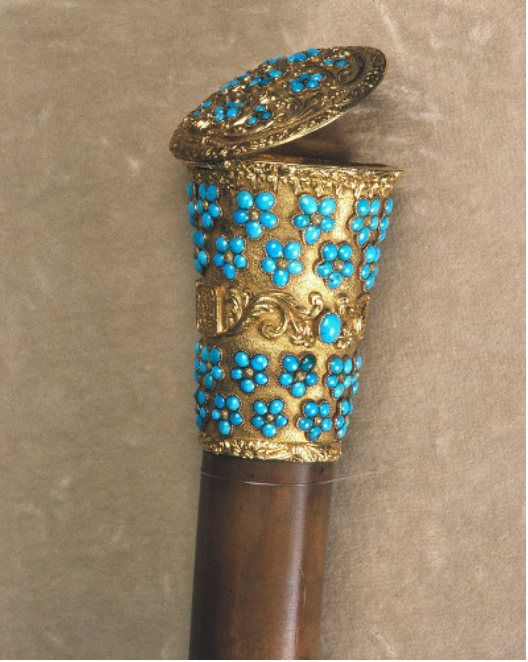
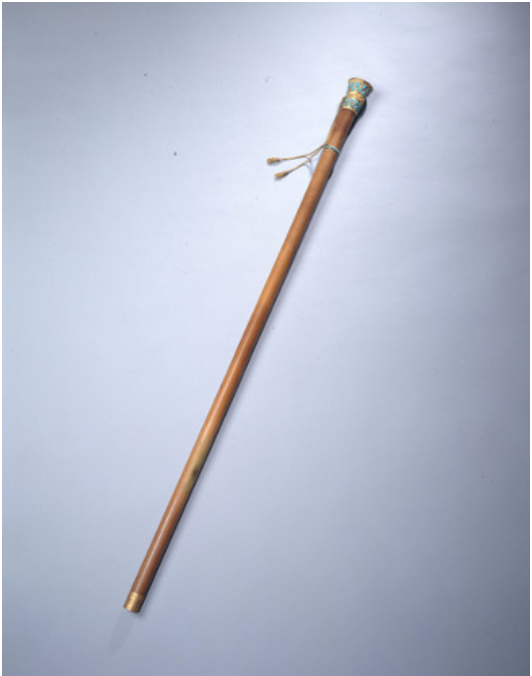
Convinced that financial ease could not be far off, Balzac bought this costly accessory on credit: the cane, commissioned from the Parisian goldsmith Le Cointe at 12 Rue de Castiglione and delivered on 18 August 1834, was still being paid off in April 1835. Its considerable price (700 francs) was justified by the gold pommel, worked with fine engraving and studded with turquoises, and this display of wealth attested to Balzac's success, having just published, one after another, several very well-received works, notably Eugénie Grandet, La Femme de trente ans, and La Duchesse de Langeais. The writer expected to further his prestige with Le Père Goriot, then in preparation. The period was likewise marked by romantic successes, with Madame Hanska and then the Countess Guidoboni-Visconti.
These jewels betray the pretensions of Balzac, who at the time held a subscription at the Opéra as well as at the Théâtre italien, and who showed himself off there in the famous "infernal box" occupied by the dandies. As arbiters of elegance, these men carried canes fitted with refined, understated mounts, whose delicacy offered a striking contrast to the writer's imposing cane. Balzac believed that the artist reigned over the world through the power of his thought, and that he therefore had every right to present himself as a prince of fashion. But he was too clear-sighted to ignore the fact that, short, round, with chipped teeth and greasy hair, he bore no resemblance whatsoever to the image of the slender, athletic dandy — the very kind his novels described. Wanting to show that he was under no illusions about this, he commissioned an accessory that was excessive in every respect: extravagant in the enormous size of both the shaft and the gold pommel, which bore a coat of arms borrowed from the Balzac d'Entraigues family, who had no connection whatsoever to the writer; unsettling too, since turquoises were generally associated with young girls. And what did the small capsule at the top of the pommel contain? Was it a lock of hair, or the portrait of his mistress? The object caused an intense sensation, and journalists and caricaturists immediately seized upon it, each trying to outdo the others in imagination. The cane also bears witness to Balzac's love for Madame Hanska, whose girlhood necklace supplied the little chains, and Balzac could proudly tell her about "...this jewel that threatens to become European [...] And if, on your travels, someone tells you that I own a fairy-cane that conjures horses, brings palaces into being, and spits out diamonds, don't be surprised — just laugh about it with me." (30 March 1835)
Magical cane ?
Is this cane truly magical? Delphine de Girardin, in her novel La Canne de Monsieur de Balzac (1836), claims that it renders invisible whoever carries it in the left hand. "Monsieur de Balzac hides himself away in order to observe; he watches, he watches people who believe themselves alone, who think as no one has ever seen them think; he observes geniuses caught fresh out of bed, feelings still in their dressing gowns, vanities in slippers, furies in nightcaps, despairs in undershirts, and then he puts it all into a book for you." How else, indeed, could one explain the coherence and psychological complexity of his characters?